One of the questions that comes up fairly early when people start looking at EV chargers is this: “What is the best charging solution for my situation?”
“Can I install a charger if I don’t have a driveway?”
It’s easy to see why people ask about the availability of a home charger. A lot of homeowners assume that owning an electric car only works if you have somewhere private to park. If the car normally sits on the street, the whole idea of home charging can start to feel unrealistic.
That assumption stops quite a few people from even looking into EVs in the first place, particularly in older areas where terraced houses and on-street parking are the norm.
But the reality tends to be a bit more complicated than that.
Some homes without driveways can still make charging work in certain situations. Others simply can’t, at least not in the traditional way people picture. The difference usually comes down to the layout of the street, local council rules, and where the car actually ends up parked most nights.
This is something that comes up regularly when installers carry out Free EV charger surveys. Streets that were built decades ago weren’t designed with electric vehicles in mind, so parking and charging don’t always line up neatly.
Because of that, the answer isn’t always a clear yes or no.
This guide looks at the practical options Irish homeowners currently have if they’re considering installing an EV charger without a driveway.
 The Basic Rule: EV Chargers Are Normally Installed on Private Property
 The Basic Rule: EV Chargers Are Normally Installed on Private Property
In most homes across Ireland, EV chargers are installed on private property. That’s the standard arrangement and it solves a lot of practical issues straight away.
Typical installation spots for a home charger include:
- the front wall of the apartment
- beside a driveway parking space
- inside a garage
- along a side wall where the home charger is usually installed for convenience
Keeping the charger within the property makes everyday charging much simpler. The cable stays within the boundary of the house, the connection to the electrical supply is straightforward, and there’s less risk of cables being damaged or getting in someone’s way.
There’s also a regulatory side to consider.
Running a charging cable across a public footpath or pavement is generally not allowed. A loose cable across the path could create a trip hazard, and it can also interfere with accessibility on the pavement.
Because of that, homes that rely entirely on street parking sometimes run into difficulties when trying to install a traditional home EV charger.
It’s not always impossible to find a charging solution — but it does make things more complicated.
If you own an electric car, where will you charge it? In Terraced Homes, the lack of parking opportunities because of Street Parking can add an extra layer of complexity.
We get this question more in older neighbourhoods.
It’s noticeable that typical Irish towns have terraced style housing with parking along the road. Sometimes you might get a space in front of your house but then other nights you might not.
That uncertainty is what complicates things.
Having a driveway helps, since the charger and car tend to end up in more or less the same location every night; without a driveway, there’s little guarantee where the car will end up relative to the charger on a given night, and it could vary dramatically. Tonight, the car is parked outside the house; last night, it was two or three spaces down the driveway.
It’s also pretty problematic from an installation point of view.
While the charge point itself looks pretty when mounted to your house, the cable then becomes a hazard trailing across your floor. Then there’s the problem when you move house, or when your friends come to visit and they’ve parked half way down the road.
Most of the speakers I work with have found terraced houses they like the look of. Once we look inside we find that the house is more than adequate as a charger, but the parking outside is not consistent enough.
Every effort has been made to attend to the smallest of details whilst still meeting the primary requirement of rapid charging. Whilst individual pavilions may appear quite large, there are inevitably some wider floorspaces than others. Additionally, some pavilions have naturally narrower plans, and these, together with the presence of trees, railings and lampposts, have influenced the arrangements for charging cables.
The house looks normal enough but the streets are very narrow.
Local Authority Rules and Footpath Safety
Most councils are quite strict regarding items that cross public footpaths and generally prefer that lawns remain clear.
Typically left in the driveway or in front of the house, car charging cables can become a tripping hazard for a few hours in the night. This danger is further heightened in low light conditions or inclement weather, where what may seem a small threat can result in serious harm.
Cables that cross footpaths are generally not permitted.
While councils are taking different approaches to the required EV charging infrastructure, a commonality exists in that the required equipment is to be installed in the ground at the property boundary.
Most electric car charger installers hit a snag when they realise that the house doesn’t have a driveway. However, this is rarely a problem of the charger itself, but rather ensuring that the public footpath is not obstructed, and ensuring that other safe means of passage are maintained for pedestrians.
Situations Where Home Charging Might Still Be Possible
In our previous paragraph, we looked at how not having a driveway could prevent car owners from being able to charge their vehicles at home. However, there are many situations where an electric vehicle home owner without off-street parking can still have a home charging point installed.
It depends on the design of the apartment and the configuration of the street.
Some houses have a fairly narrow frontage, which means that the car might be parked in a fairly standard position night after night, which in turn means that the position of the charger might be constrained by the footprint of the house. This could mean that the routing of the cable needs some thought to ensure it doesn’t have to cross the main walking area of the footpath.
Another scenario appears with rear access lanes, which can limit charging options for electric vehicle home owners.
If your terraced house has a section of the back that could potentially be used for something else, then installing your car charger might actually be made easier by the way the house is arranged (ie having access to a rear laneway/parking space). But this doesn’t mean all decisions have been taken out of your hands, and you will have to consider how you use this space currently and whether installing a charger will inconvenience you by no longer being able to park (without a quick step) out on the road.
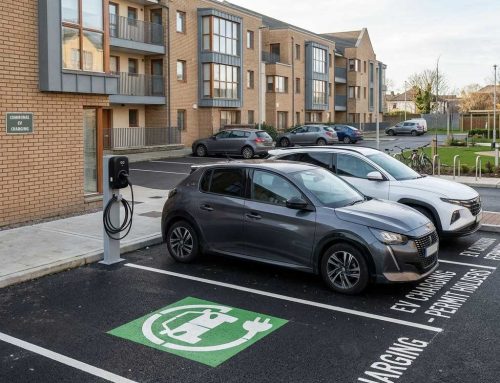
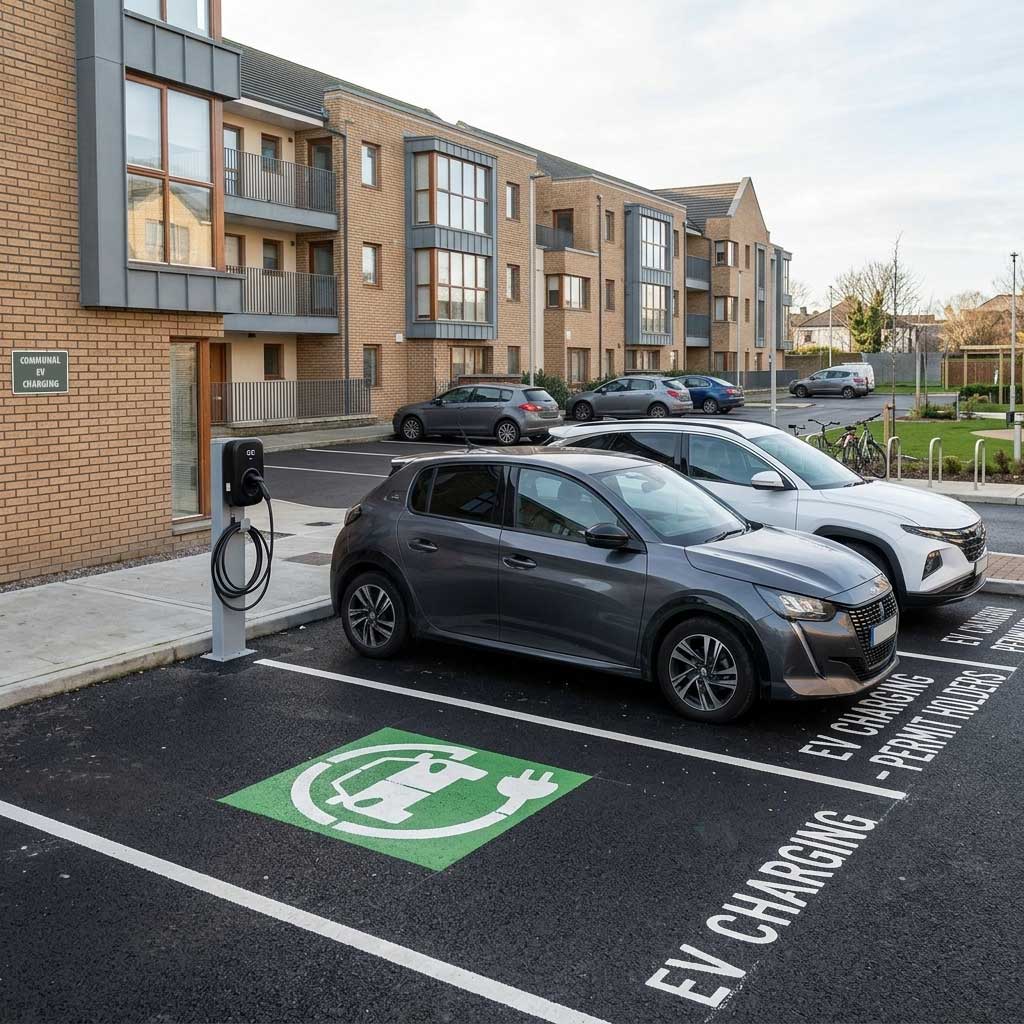
Ideally, the charging point would be installed in a driveway, but it could also be suitable for shared areas or smaller private car parks. The space would need to be available to you at all times and for easy access on a daily basis.
We could spend all day talking about watts, kilowatts, and the details of chargers, but it’s also important to consider the context in which you’ll be using one: namely, where you park your car. It’s a simple consideration, perhaps, but a pretty important one.
That one detail tends to shape everything else.
Since the car returns every night to the same location, it was much easier to plan for this mod vs having the car move every day. It would have been a much trickier problem if the car had parked in different locations every night.
You can design all the level you want, but without consistency in parking from frame to frame, you will still get some wacky oscillations.
Alternatives for Homes Without Driveways
While installing a charger at your house may not be possible, that does not necessarily mean you cannot have an EV. There are various alternatives and solutions being proposed.
Contrary to what some might suggest, most drivers do not rely solely on a single location for charging their cars, instead charging in multiple ways and locations.
So, how easy is it to charge at home? Well, over the last few years the number of public chargers has been increasing steadily. What’s really helpful is that a lot of them are located in places you would already go to such as shopping centres, supermarkets, hotels etc. And even if you are on the move, you can charge at motorway services.
There are also opportunities for those who install points for workplace charging in order to facilitate those who are employed by the organisation and who commute to and from work by car, being able to regularly charge their vehicles.

What Installers Usually Check First
One of the questions we hear quite a lot is: “Can I install an EV charger without a driveway?”
Most people naturally focus on the parking side of things first. They look at the space outside the house and think in simple terms — if a car can fit there, then charging should be possible too.
But there’s usually more to it than that.
What often gets overlooked is the electrical side of the installation. It’s not just about where the car can sit — it’s about how safely and practically the charger can connect back to the house, and whether that setup will actually work day to day without creating issues.
Where does the car normally end up parked?
That’s usually the starting point.
If the space outside the house is available most nights, with the odd exception, that at least gives something to work with. It doesn’t have to be perfect — but there needs to be some level of consistency.
We also look at anything else using the space. For example, if there’s a motorbike parked to the side of the property, could that be moved to the rear or into a separate area? Small changes like that can sometimes free up a more reliable position for the car and make charging a lot easier to plan around.
Is the cable going to cross a public footpath?
Some of these questions are meant to measure the direction and strength of the observed trend. In some instances, the answer is quite obvious.
In a lot of cases, the final setup is largely decided by the layout of the property itself.
Things like how the house is positioned, access to the side or rear, whether there’s a back lane, and the size and location of any parking space all come into play. You can plan as much as you like, but the physical layout usually dictates what will and won’t work.
There are also situations where, at least for now, the parking setup just isn’t suitable for a home charger.
When you see examples of cables stretched across narrow streets or cars parked a few spaces away from the house, it’s not someone doing something wrong — it’s usually someone trying to work around a layout that was never designed for this. In many cases, the limitation comes down to the street itself rather than the house or the charger.
The Reality for Most Street-Parking Homes
In many Irish homes, especially older streets, private driveways or designated parking spaces directly outside the house aren’t always available. A lot of parking is informal — first come, first served — which makes planning a fixed charging setup more difficult.
There’s also a bit of confusion around what’s allowed. Some homeowners assume they can install a charger at the front and run a cable out when needed, but in reality, anything that involves crossing a public footpath tends to be restricted.
The main issue comes down to consistency.
For a home charger to work properly day to day, the car needs to be able to park in roughly the same spot each evening. That’s what makes the setup practical. If the parking varies from night to night, it becomes very hard to rely on a fixed charging point.
That doesn’t mean EV ownership is off the table, but it does mean the setup needs to be thought through a bit more carefully, especially in areas where parking isn’t predictable.
In reality, most drivers in terraced streets don’t rely on just one way of charging.
They tend to mix it. A bit of public charging close to home, maybe some charging at work, and the occasional top-up while out at shops or on longer journeys. It becomes more of a routine than a single fixed setup.
That approach works well enough for most day-to-day driving. Even if you’re not charging at home every night, the car can still comfortably handle typical mileage once there are a few reliable options in the mix.
There are different types of charging available — home charging, fast charging, and ultra-rapid points — but what’s really changed in recent years is how many of these options are now available. Public charging in particular has expanded quite a bit, which makes it easier to manage without relying entirely on a charger at home.
Final Practical Advice
If you don’t have a driveway, consider where you park your car when shopping for an EV charger.
That single detail answers most of the questions.
If you park close to your home, then there may be some options for a charger installation. If you rarely park on a street near to your home, and it varies from day to day, then it is likely that a private charger installation will be very difficult to plan.
Drivers are currently left to their own devices to find local charging points or have to rely on their employer’s facility for charging their Electric Vehicle.
There’s a common perception that electric vehicles are not for those who don’t have a driveway. But while that may add an extra layer of complication, it’s not an insurmountable barrier to ownership.
You can often gauge early on whether a property and parking configuration will be a good fit, before investing too much time researching unworkable options.