Table of Contents
- Why This Question Comes Up So Often
- Why Communal EV Charger Installations Are Different
- Older Apartment Blocks vs Newer Developments
- Assigned Parking vs Shared Parking
- Load Balancing and Electrical Capacity
- Future-Proofing Apartment Developments
- Why Site Surveys Matter
- Final Practical Advice
When considering Communial Parking EV Charger Installation, one thing that catches apartment owners off guard with EV charging is how quickly the conversation stops being about the charger itself.
People usually begin by comparing brands, charging speeds, apps, cable lengths, all the usual stuff. Then somewhere along the line they realise the bigger question is actually this:
“Can we even install one here in the first place?”
That’s the part that tends to slow everything down.
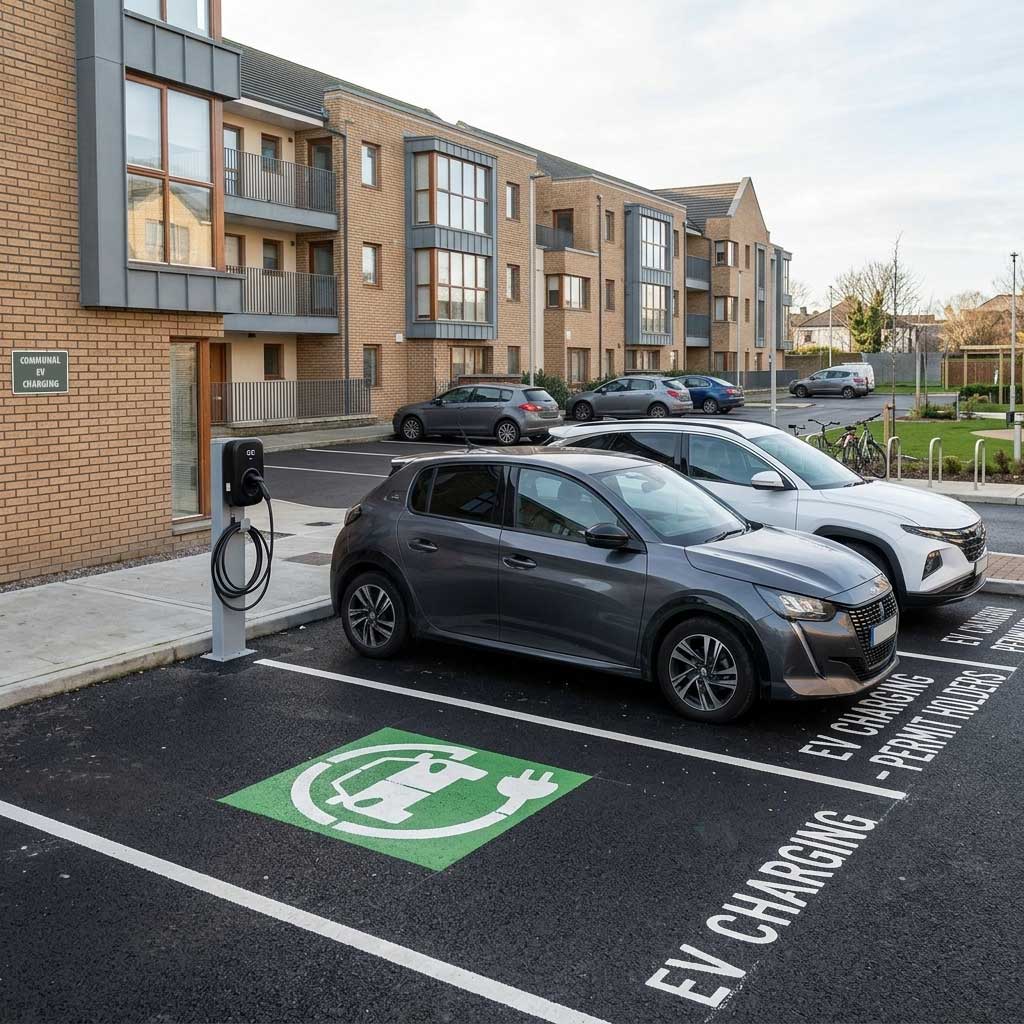
With a normal house and driveway, the home charging process for electric cars is fairly straightforward. But communal parking areas are different. Suddenly, there are management companies involved, assigned bays, underground car parks, electrical rooms, shared supplies, access permissions, and twenty different opinions from residents who all want something slightly different.
Why This Question Comes Up So Often
Some apartment developments are actually quite well set up for EV charging stations, even if they weren’t designed for it originally. Others become complicated very quickly once the first site survey happens.
We’ve seen both.
A lot depends on how the parking area is laid out and how the building itself was originally wired. Some newer developments already have spare electrical capacity and sensible cable routes built into the basement. In those cases, installing a communal parking EV charger can be surprisingly manageable.
Older apartment blocks are usually where things get trickier.
- underground parking with concrete ceilings everywhere
- meter rooms at the opposite end of the building
- no spare containment routes for future charging station expansion
- residents parking in different bays every week
- management companies worried about future disputes
That’s normally where the real planning starts.
Why Communal EV Charger Installations Are Different
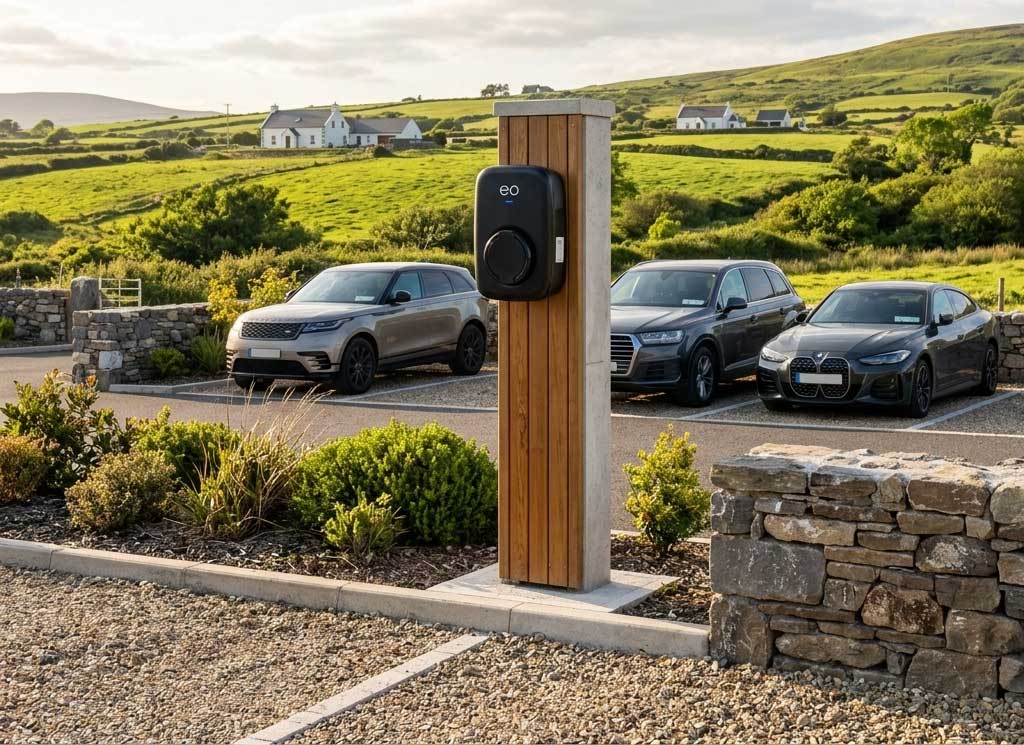
And to be fair, some of the concerns are valid enough. Once chargers start appearing in shared spaces, somebody has to decide:
- who pays for electricity
- who maintains the chargers
- whether bays become reserved
- what happens when more residents buy EVs later on
Because the first charger is rarely the last one.
That’s something apartment management companies have become much more aware of over the last couple of years. Early on, some developments treated EV charging like a once-off request for a single resident. Now, most realise it eventually becomes a wider infrastructure issue for the whole building.
Older Apartment Blocks vs Newer Developments
The practical side matters too.
We’ve surveyed apartment car parks where the parking bay itself looked perfect until you traced the cable route back to the electrical supply and realised the run would need to cross almost the entire basement. Jobs can change very quickly once that happens.
Sometimes the opposite happens too.
A development can look awkward initially, but then you find there’s an unused service riser nearby, decent access above the parking spaces, and enough spare electrical capacity already available. Suddenly, the project becomes much more realistic than people expected.
That unpredictability is why communal parking EV charger projects nearly always start with a proper survey rather than a fixed online quote.
Assigned Parking vs Shared Parking
The parking arrangement itself also matters more than people think when it comes to installing charge points.
Assigned spaces are usually much easier to work with because the car charger can be linked directly to a specific apartment or resident. Shared or unallocated parking creates a different challenge entirely because the charger effectively becomes communal infrastructure rather than an individual installation.
That changes the conversation.
At that stage, management companies often start looking at:
- shared charging systems
- app-controlled access
- RFID cards can be used for accessing public chargers
- load balancing systems are essential for managing multiple electric vehicle charge points efficiently
- billing software
- future expansion planning
Especially in larger developments where multiple car chargers can be installed.
Load Balancing and Electrical Capacity
Load balancing comes up quite a lot now, actually.
Most apartment buildings weren’t designed with dozens of EVs charging overnight. If too many chargers pull full power at once, the building supply can quickly come under pressure. Smart load balancing helps spread available power more intelligently between chargers rather than trying to upgrade the entire electrical supply immediately.
That can make a huge difference financially.
Without it, some developments would face very expensive ESB upgrade works much earlier than expected.
Future-Proofing Apartment Developments
One thing worth saying, though: people sometimes assume communal EV charging means every resident needs a charger immediately.
In reality, most developments start much smaller.
It might begin with:
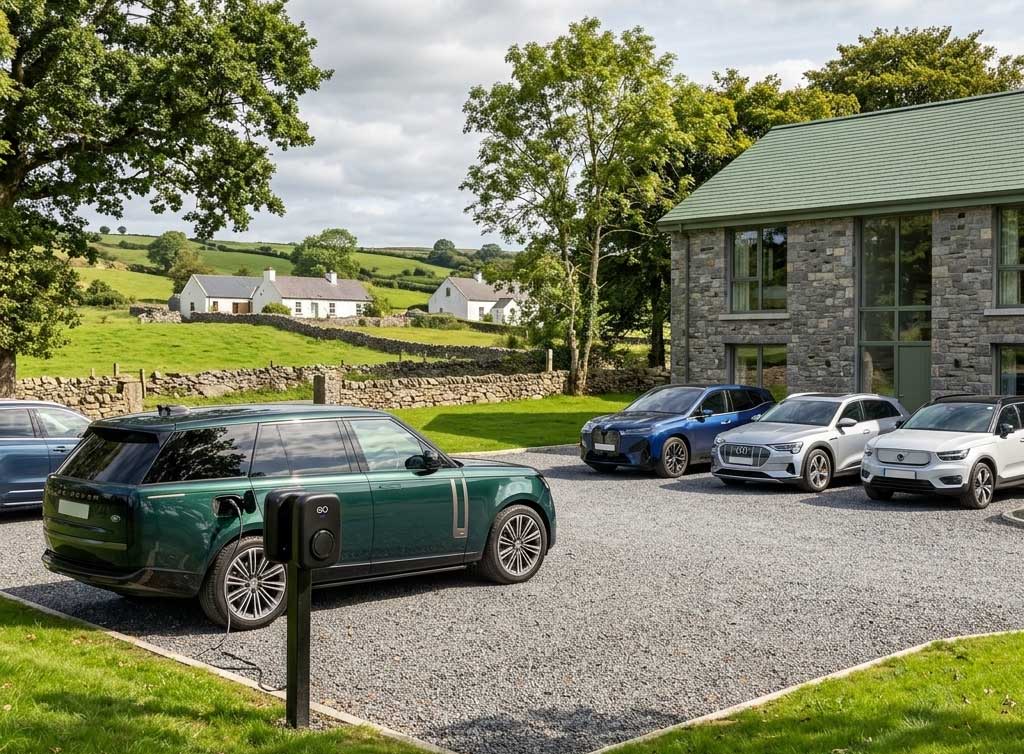
- one or two shared chargers
- several dedicated resident chargers
- spare ducting for future expansion of charging stations
- groundwork done in stages
That phased approach is usually far easier for management companies to approve because it avoids massive upfront costs while still preparing the building for future demand.
And honestly, future-proofing for electric vehicle charging is becoming a major part of these conversations now.
Apartment buyers increasingly ask about EV charging before purchasing properties. Developments with no realistic charging plan at all are starting to look slightly behind the curve, particularly in Dublin commuter areas where EV ownership is growing steadily.
We’ve even seen situations where management companies initially resisted installations, only to revisit the conversation a year later after multiple residents requested charging around the same time.
That tends to happen once EV adoption reaches a certain tipping point within a development.
Why Site Surveys Matter
There’s also a misconception that every communal parking EV charger project becomes hugely complicated.
Some absolutely do.
But some are relatively straightforward once:
- permissions are clear
- parking is assigned
- electrical capacity is available
- cable routes are practical
The difficult part is usually figuring out which category the building falls into before people spend too much time or money chasing the wrong solution.
That’s why early surveys matter for planning future charging station installations.
Not because installers are trying to complicate things — more because apartment developments can vary massively from one building to another even when they look almost identical from outside.
Two neighbouring apartment blocks can end up with completely different electric vehicle charging options purely because:
- one has spare electrical capacity
- one has better basement access
- one has assigned parking
- one management company is proactive
- one building was wired differently during construction
That’s the reality of it.
Communial Parking EV Charger Installations – Final Practical Advice
For residents, the main issue is whether their new electric vehicle charging point will actually be practical to use on a day-to-day basis.
“Will this work properly every evening?”
Access to the charge point, parking consistency, billing for usage, management of the charge points, and future expansion all become part of the conversation very quickly.
That’s usually the sign that the project was planned properly from the start.
A scheme that works well tends to work quietly in the background. Residents park, plug in, charge overnight, and get on with their routine without constantly thinking about the infrastructure behind it.
Related search terms: communal parking EV charger, communal EV charging Ireland, apartment EV charger Ireland, shared parking EV charger, home charger, electric car chargers, parking spot, charger installed, smart charger, home EV charging, designated parking, switching to an EV, charger unit, faster charging, footpath, planning permission, charging infrastructure, owners’ management company, installation costs, off-street parking, on-street parking, charger costs, communal space, charging of electric vehicles, 7kW EV charger, tethered EV charger, housing schemes, grant support, type of charger, use the EV, county council, DC charger, DC charging, charge your car, designated parking space, new housing estates, public parking, Type 2 EV charger, ZEVI, AC to DC charging, private driveway, government policy, allowed to install EV charger, Department of Housing, electrical power, eCars Ireland, public liability, EV uptake Ireland, electrical contractor, meter box, 22kW AC charger, apartment block EV charging, EV charger for apartments, EV charging apartments Ireland, EV charging shared spaces, EV charging apartment car park, EV charger apartment complex, EV charging underground car park, apartment parking EV charger, communal car park EV charging, EV charger management company Ireland, apartment EV charging infrastructure, EV charger shared car park, electric vehicle charging apartments, EV charger installation Ireland, EV charger grants Ireland, apartment charger installation, multi-unit development EV charging, EV charging MUD Ireland, apartment charging solutions Ireland, EV charger for housing estates, EV charging communal areas, smart EV charging Ireland, EV charger electrical capacity, EV load balancing Ireland, EV charger site survey, apartment EV charging costs, EV charger planning Ireland, EV charger permissions Ireland, EV charger residents association, EV charger billing system, EV charging for residents, apartment EV charging setup, communal charger installation Ireland